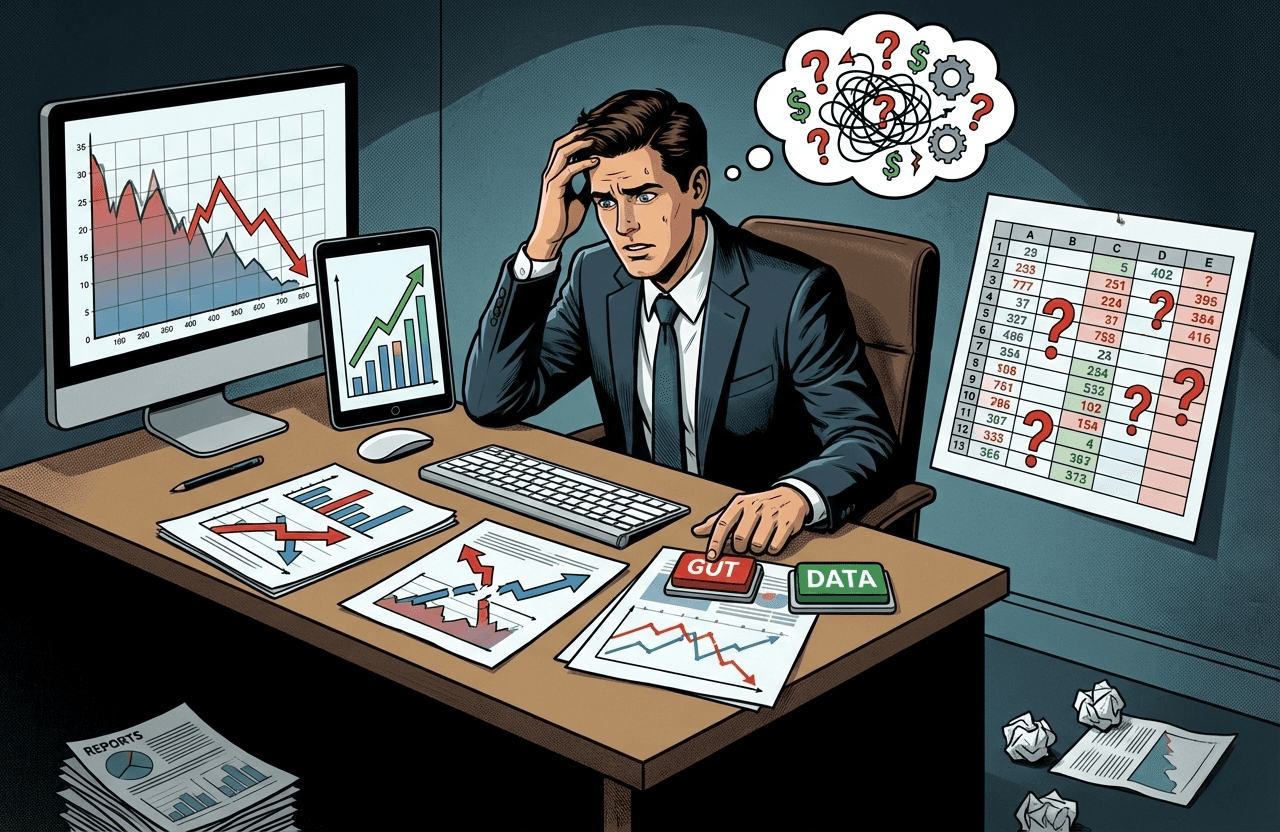

Founders rarely stop trusting their numbers when the business is fragile. Trust usually breaks later, when revenue is growing, teams are in place, and reporting looks more sophisticated than it ever has. Dashboards multiply. Reviews become more frequent. And yet decisions feel heavier, slower, and more contested. Founders start asking for one more report, one more breakdown, one more sense-check, not because they want more detail, but because the numbers no longer feel safe to act on.
In practice, when a founder says “I don’t trust the numbers,” they are not criticising accuracy in isolation. They are describing a loss of confidence in decision-making. The issue is not whether the data exists, but whether it supports clear choices about where to invest, what to prioritise, and how to explain direction to the team. When numbers feel unstable or open to interpretation, instinct creeps back in, not as a preference, but as a coping mechanism.
The CALM framework: Diagnosing where trust breaks down
When we work with leadership teams in this position, we do not start by changing tools or improving reporting. Those are execution moves. Trust breaks earlier, and in predictable places. Over time, we have found that mistrust in numbers almost always maps back to one or more of four underlying issues. We use a simple framework as a first diagnostic pass: C-A-L-M.
CALM stands for Consistency, Accountability, Logic, and Meaning. It is not a reporting framework or a dashboard model. It is a way of pressure-testing whether numbers are actually serving decisions. When founders distrust their numbers, the root cause will always sit in one or more of these areas. Understanding which ones are failing is what allows trust to be rebuilt deliberately, rather than through guesswork or over-optimisation.
Consistency
Consistency is not about producing identical numbers across departments. That is neither realistic nor desirable. Consistency is about alignment and reconciliation. In healthy businesses, different views of performance are expected but explainable. A finance number and a marketing number can diverge materially and still be trusted if everyone understands what each represents, how it is calculated, and how both relate back to a shared commercial baseline.
In unhealthy businesses, those differences trigger debate, defensiveness, or quiet avoidance. Leaders stop asking why numbers do not match because the explanations are messy, political, or require stitching together multiple systems to make sense of them. The practical test is simple. When metrics differ across teams, can someone explain why without turning it into a meeting? Is there a clear answer to which number is used for decisions and which ones provide context? If gaps cannot be calmly explained, founders will not trust the numbers, because unexplained variance signals a lack of control.
Accountability
The second failure point is ownership. As organisations scale, metrics often exist without clear accountability. Either no one owns them, or too many people half-own them. In that environment, accuracy becomes everyone’s job and therefore no one’s job. When a number looks wrong, teams interpret rather than investigate. When performance shifts, decisions stall because no one wants to be responsible for declaring what it means.
This burden then rolls up to the founder. They become the translator between departments, the referee in disagreement, and the final arbiter of reality. That is not leadership leverage. It is a system gap disguised as leadership judgement. A business cannot scale decision-making if it does not scale ownership of measurement. Each core metric needs a named owner responsible for its definition, integrity, and interpretation, with a clear process for resolving challenges when trust is questioned.
Logic
Many businesses believe logic is their strength because they have dashboards, reporting cadence, and long lists of metrics. The presence of numbers is mistaken for understanding. Logic is not about volume. It is about whether the numbers explain what is happening inside the commercial engine. A business can report activity flawlessly and still lack logic if it cannot explain causality.
Weak logic shows up when metrics are reviewed but rarely acted on. Leading and lagging indicators are blended together, confusing timelines and priorities. Teams chase outcomes that have already happened while missing early signals of what is coming next. Assumptions behind key metrics are rarely written down, existing informally until people change and the logic collapses. The result is reporting that looks professional but does not reduce uncertainty. It documents performance without supporting decisions.
Meaning
Meaning is the most overlooked element and often the simplest. Numbers only matter if they change behaviour. A metric is not valuable because it is accurate or widely reported. It is valuable only if movement triggers a decision. If a number can rise or fall without consequence, it is noise, regardless of how clean the data is.
The test here is blunt. If this metric changed materially tomorrow, what would we do differently? Which numbers would genuinely worry leadership if they moved, and which ones would simply be noted and ignored? Do teams know what “good” looks like, or are they reacting emotionally to variance without thresholds or context? When meaning is absent, founders feel unease because they are surrounded by information that does not guide action. They can see movement, but they cannot translate it into direction.
Restoring trust in practice
Rebuilding trust does not start with more data. It starts with clearer definitions and decision structures. In practice, a few disciplined actions surface the core issues quickly.
First, ask the leadership team a forcing question: what are the three numbers that tell us whether we are okay? Not ten. Not twenty. Three. The purpose is not to oversimplify the business, but to expose whether there is shared understanding of commercial reality. Wide variation in answers is a signal of misalignment.
Second, take one of those numbers and trace it end to end. Where does it come from? Which system produces it? How is it calculated? Who owns it? When does it update? This exercise almost always reveals fragmentation, inconsistent timing, manual adjustments, and blurred separation between attribution, recognised revenue, and cash. The goal is not perfection. It is explainability.
Finally, ask the question dashboards tend to avoid. If this number changed materially, would it change a decision? If the answer is no, either the metric lacks meaning, or the organisation lacks a mechanism to act on insight. Both undermine trust. Removing noise is often more valuable than adding new signals, because it reduces the mental overhead that pushes founders back toward instinct.
Conclusion
Founders do not stop trusting their numbers because growth becomes harder. They stop trusting them because the systems around those numbers stop supporting clear decisions. As complexity increases, misalignment creeps in, ownership blurs, logic weakens, and reporting expands without improving confidence. The problem is rarely a lack of data. It is a lack of shared understanding around what matters, who owns it, and how it should be used.
That is why we use the CALM framework internally as a diagnostic before optimisation begins. It gives leadership teams a way to surface where trust is breaking down and to reconnect numbers to decisions without the conversation dissolving into opinion or debate. Even when it simply makes the gaps visible, it has already done its job.
More articles
Explore more insights from our team to deepen your understanding of digital strategy and web development best practices.