
Why This Comparison Exists
B2B brand positioning is not a tagline exercise. It is the commercial foundation that determines whether your company gets remembered, shortlisted, and chosen, or ignored in favour of a competitor who simply communicated better.
The stakes are real. 6sense’s 2025 buyer research found that 95% of winning vendors are already on the buyer’s Day One shortlist. Four out of five deals go to the pre-contact favourite. If your positioning is vague, you are not losing a branding argument. You are losing revenue before you know a deal exists.
For B2B companies in Ireland, finding the right positioning partner is complicated by the sheer number of agencies that list “branding” as a service. Some are logo shops. Some are campaign agencies. Some are strategic consultancies that connect positioning to website architecture, SEO, sales enablement, and revenue systems. The differences matter.
This guide compares ten options, explains what good B2B positioning should include, and gives you a decision framework built around how B2B buying actually works.
Explore CSM’s brand strategy services to see how positioning connects to commercial growth.
What Is B2B Brand Positioning?
B2B brand positioning is the strategic choice of where your business sits in the market, who it serves, what buying situation it wants to be remembered for, and why a buying group should choose it over alternatives.
That last part matters. B2C positioning often targets an individual. B2B positioning must survive a committee: the CEO who cares about strategic fit, the CFO who cares about risk, the technical evaluator who cares about integration, the procurement lead who cares about compliance, and the internal champion who needs to sell the decision upward.
Strong B2B positioning includes:
A clear ideal customer profile
A defined market category or frame
Named competitive alternatives
Differentiated value that the market actually cares about
Proof that the claim is real
Messaging that works for different stakeholders
An identity system that builds recognition
A website that converts
Sales materials that help champions sell internally
Search visibility so buyers find you before they know they need you
LinkedIn’s B2B Institute argues that most purchases start in memory, not Google. The job of positioning is to build those memories, linking your brand to the specific buying situations where you want to be considered.
Ehrenberg-Bass describes this as mental availability (being easy to think of) and physical availability (being easy to find and buy). In B2B, physical availability now includes your website, search presence, AI search visibility, distributor portals, and partner ecosystems.
Good B2B brand positioning should be visible in every commercial touchpoint, not just a strategy PDF sitting on someone’s desktop. For a deeper look at brand as a commercial asset, consider how positioning connects to enterprise value and long-term trust.
Why B2B Positioning Matters More Than Ever
Buyers decide before you know they exist
6sense found that B2B buyers evaluate an average of 5.1 vendors and have prior experience with 3.8 of them. They fill 3.6 shortlist spots on Day One. LinkedIn’s B2B Institute reports that 92% of buyers with a “Final Four” ultimately choose a brand they shortlisted from the start.
This means your positioning work is not about winning a pitch. It is about being remembered months before the pitch happens.
Buying groups are larger and harder to influence
Gartner’s 2025 messaging research found that buying groups are 40% less likely to complete a high-quality purchase when communication is tailored only to the buyer’s role. That sounds counterintuitive, but role-only messaging can fragment group confidence. The committee needs shared language, shared proof, and shared reasons to believe.
Practitioners on LinkedIn echo this. One agency specialising in healthcare B2B argues that deals do not die on product quality; they die in committee, because legal, finance, IT/security, and clinical directors all influence the outcome.
Peer trust outweighs vendor claims
Bain’s research found that B2B buyers trust community sources over ads and vendor-controlled channels. More than 50% of buyers said manager-level colleagues significantly influence purchasing decisions. For director-level staff below VP, that number climbed to 80%.
Practitioners on Reddit reinforce this. In a discussion about what actually moves B2B deals forward, users said momentum comes when stakeholders feel confident they will not inherit a mess after purchase. They recommend business cases, ROI models, cost-of-inaction framing, and information that internal champions can forward to sceptical colleagues.
Thought leadership is part of positioning, not a side project
The 2025 Edelman-LinkedIn Thought Leadership Impact Report found that 73% of target decision-makers say thought leadership is more effective than conventional marketing materials at demonstrating potential value. Among hidden decision-makers (the influencers who shape committee consensus), 79% are more likely to advocate for proposals from companies that consistently produce high-quality thought leadership.
This connects directly to positioning. If your agency builds a brand identity but ignores thought leadership, case studies, and expert content, the position will not stick with the people who actually influence buying decisions.
At-a-Glance Comparison Table
Agency | Best for | Pricing visibility | Positioning depth | Execution after strategy | Main tradeoff |
|---|---|---|---|---|---|
CSM Agency | B2B growth systems: positioning, web, SEO, sales enablement | Custom / free 30-min consult | High | High | Not for basic logo-only work |
Seichō | Premium B2B repositioning and acquisition readiness | Quote-based | High | Medium-high | Pricing not public |
Squaredot | B2B tech campaigns and demand | Quote-based | Medium-high | High | Less public pricing/review depth |
Principle | High-craft identity programmes | Quote-based | Medium-high | Medium | Less SEO/revenue ops focus |
SHAPE | Brand-led development and CX | Quote-based | Medium-high | Medium | Less B2B growth-system focus |
Brand Elevation | Brand activation and collateral | Quote-based | Medium | Medium | Less technical B2B focus |
Design Minds | B2B branding basics and visual identity | Request quote | Medium | Medium | Thin public buyer guidance |
CDG | Workshops and design thinking | Quote-based | Medium-high | Medium | Limited visible proof/pricing |
Red & Grey | Distinctive visual design | Quote-based | Medium | Medium | Less B2B-specific positioning |
Everblue Digital | SME branding + web + digital marketing | Retainers from €3,000/month (digital marketing) | Medium | High for SME digital | Less enterprise B2B specialisation |
10 B2B Brand Positioning Agencies in Ireland
1. CSM Agency
Best for: Mid-market B2B companies that need positioning connected to website, SEO, sales enablement, and measurable commercial growth.
CSM Agency is the strongest overall choice for B2B companies where brand positioning is tangled up with deeper commercial problems: unclear messaging, weak website conversion, underperforming organic visibility, inconsistent sales materials, or complex buying journeys that need simplifying.
The agency operates on a strategy-to-execution model. Rather than delivering a positioning deck and walking away, CSM connects brand strategy to website architecture, SEO, AI search optimisation, conversion optimisation, sales collateral, and analytics. This matters because, as one LinkedIn practitioner argues, B2B positioning is “80% execution and 20% decision.” The market only grants a position when the company reinforces it repeatedly.
Pricing: Custom-scoped based on brand, website, SEO, and growth needs. A free 30-minute consultation is available via their book a call page. Best suited to businesses that want a strategic partner, not a low-cost logo package.
Key capabilities:
Brand strategy, positioning, and messaging
Visual identity and brand systems
Website strategy, UX design, development, and CMS implementation
Conversion rate optimisation
SEO, GEO, and AI search optimisation
Sales enablement assets: pitch decks, case studies, proposal templates
ABM and go-to-market support
Analytics, attribution, and commercial intelligence dashboards
Ongoing brand growth and SEO retainers
Proof: CSM’s case studies show the kind of complexity most brand agencies avoid. For Medentech (Kersia Group), they built compliance-ready ABM decks for non-English distributors and helped secure new pharma distribution partnerships across Malaysia, Singapore, and Vietnam. For Aquatabs, they built a distributor portal and enablement system spanning 200+ distributors and 100+ markets. For Centric Health, they redesigned booking and journey architecture across 70+ clinics.
Tradeoffs:
Not the fastest option if all you need is a logo refresh
Diagnostic-first approach may feel slower than jumping straight into creative
Likely not the lowest-cost fit for very small businesses seeking basic brand assets
Verdict: Choose CSM if your B2B brand positioning problem is really a growth-system problem. When positioning needs to translate into a website that converts, SEO that compounds, and sales materials that help champions close deals internally, this is the strongest fit.
2. Seichō
Best for: Founder-led B2B companies focused on premium pricing, repositioning, or acquisition readiness.
Seichō positions itself specifically around B2B brand strategy for Dublin companies that want to charge more. That framing is commercially sharp and narrows their appeal to businesses where pricing power is the goal, not just visual polish.
Pricing: Quote-based. Seichō says every project is scoped by requirements, market complexity, and commercial objectives. Comprehensive B2B branding projects typically take 8 to 14 weeks. They also offer a paid, time-boxed brand audit as a starting point, plus a free five-minute brand audit tool.
Key capabilities:
Brand strategy and positioning
Visual identity design
Brand messaging and verbal identity
Brand activation and rollout
Web design integration
B2B SaaS and biotech positioning support
Dublin and Boston presence
Proof: On-site case studies include B2B brand strategy projects such as Breezemount, Kerb Appeal, and Tapson, positioned around commercial value and acquisition readiness. Third-party review visibility is limited.
Tradeoffs:
Strong B2B positioning message, but public pricing is not transparent
Less visible proof of deep SEO, AI search, analytics, or complex distributor enablement
Strongest for brand strategy and identity cohesion rather than full commercial growth systems
Verdict: Choose Seichō if you are a founder-led B2B company in Dublin looking for brand strategy with a premium-pricing and repositioning narrative.
3. Squaredot

Best for: B2B technology companies that want brand positioning connected to campaigns and demand generation.
Squaredot is a specialist B2B marketing agency rather than a general design studio. Their approach spans branding, content strategy, lead generation, and account-winning campaigns, making them a strong fit for B2B tech companies that need positioning to drive demand quickly.
Pricing: Quote-based. Pricing details are not publicly disclosed.
Key capabilities:
Branding and brand strategy
Content strategy and creation
Creative services
B2B campaigns and lead generation
Inbound marketing
ABM-style account-winning support
Proof: A client review on DesignRush describes Squaredot taking a senior leadership team through self-discovery around brand positioning, marketing strategy, identity, and market position. On GoodFirms, they are described as a “Creative B2B Digital Marketing Agency” for ambitious B2B tech companies.
Tradeoffs:
Public pricing and independent review depth are limited
May be better for B2B tech campaign work than for complex website architecture, healthcare journeys, or distributor portals
Less visible specialisation in SEO/GEO or AI search optimisation
Verdict: Choose Squaredot if you are a B2B tech company looking for brand positioning that quickly connects into campaigns, content, and demand generation.
4. Principle
Best for: Established organisations that need high-quality identity programmes and brand campaigns.
Principle is a well-established Dublin creative agency with strong portfolio credibility. Their work includes recognisable brands such as UNICEF Vaccine Fund, RE-TURN, and ZAGG On Demand, suggesting a level of creative craft that appeals to organisations where brand visibility and design quality are priorities.
Pricing: Quote-based. Buyers should ask whether strategy, naming, messaging, identity, campaign creative, rollout, and guidelines are included separately or bundled.
Key capabilities:
Brand strategy
Identity design
Creative campaigns
Full branding programmes
Visual and verbal identity refreshes
Proof: On-site testimonials are strong and named. One client describes the team understanding brand challenges and leaving them “on a strong footing for growth.” Another says the agency helped identify opportunities beyond a logo refresh and realign corporate and product identities.
Tradeoffs:
Strong creative and identity credibility
Not positioned narrowly around B2B commercial systems, SEO, AI search, or analytics
Better for brand identity and campaign craft than for revenue operations or complex digital infrastructure
Verdict: Choose Principle if your priority is a polished, strategically grounded identity programme from an established Dublin brand creative agency.
5. SHAPE Brand Development
Best for: Businesses that want a structured, brand-led development programme including CX and brand activation.
SHAPE has been operating since 2006 and positions itself as “100% brand-led,” meaning positioning is defined before creative execution begins. Their client list spans pharma, healthcare, finance, hospitality, and aviation.
Pricing: Quote-based. Ask whether research, brand auditing, positioning, identity, CX, and activation are all included or separately priced.
Key capabilities:
Brand design and creative design
Websites and packaging
Naming and taglines
Rebranding and brand auditing
Positioning and strategy
Market research
Customer experience design
Brand activation and architecture
Proof: Client logos include Dublin Aerospace, Trinity Care, and Viatris. Third-party review evidence is limited in publicly available sources.
Tradeoffs:
Strong brand-development language and long operating history
Less obviously specialised in B2B revenue systems, SEO, AI search, ABM, or sales enablement
Buyers should ask for proof in their specific B2B category
Verdict: Choose SHAPE if you want a brand-led Dublin agency with a long track record and a structured approach to positioning before design.
6. Brand Elevation

Best for: Businesses that need brand strategy connected to practical activation, collateral, and campaign support.
Brand Elevation offers a broad scope: brand strategy, creative design, promotional material, branded merchandise, print, campaign management, and digital marketing. They operate from Dublin and Banbridge.
Pricing: Quote-based. Their contact form asks for an estimated budget, suggesting custom scoping.
Key capabilities:
Brand strategy and brand activation
Creative design
Promotional material and branded merchandise
Campaign management
Digital marketing and web design
Print production
Proof: Yell shows Brand Elevation with 5.0 from 2 ratings, with reviews praising ideas, service quality, and a business-oriented attitude. On-site testimonials praise professionalism and long-term support.
Tradeoffs:
Strong practical activation and collateral fit
Less specifically positioned around complex B2B buyer journeys, technical markets, or SEO/GEO
Better for businesses that need broad brand support than deeply technical B2B repositioning
Verdict: Choose Brand Elevation if you need brand strategy connected to activation, promotional assets, and campaign support under one roof.
7. Design Minds

Best for: Companies that need straightforward B2B branding and visual identity work.
Design Minds positions itself with an exact-match “B2B Branding Services” page, listing brand strategy, messaging, identity, launch, and graphic design. The agency has won European Design Awards and a Worldwide Logo Design Award.
Pricing: Not disclosed. The page invites users to request a quote by email or phone.
Key capabilities:
Brand strategy and brand messaging
Brand identity and brand launch
Graphic design
Customised B2B branding services (scalable up or down)
Proof: The page highlights design awards, but visible third-party user review depth is limited.
Tradeoffs:
Good keyword match and simple service breakdown
Page is relatively thin compared with stronger buyer guides
Less explicit evidence of B2B sales enablement, SEO, AI search, or complex journey implementation
Verdict: Choose Design Minds if you want a straightforward B2B branding and identity partner with a strong design-led heritage.
8. CDG

Best for: Leadership teams that need structured brand strategy workshops and design-thinking-led clarity.
CDG has operated from 1989 to 2026 across Dublin, London, and Boston. Their approach centres on workshops, brand archetypes, personas, and customer journey mapping. They describe their engagement as two two-hour sessions designed to explore every corner of the brand.
Pricing: Quote-based. No public pricing visible.
Key capabilities:
Digital brand strategy
Brand strategy sprints
Design thinking and design innovation
Customer journey mapping
Brand archetypes and brand personas
Workshops and toolkits
Proof: The visible brand strategy page does not provide much independent review evidence. Stronger on process description than third-party validation.
Tradeoffs:
Strong language around strategic clarity and workshop facilitation
Limited public pricing and limited visible proof
Buyers should ask how CDG turns workshop outputs into implementation across website, search, sales, and measurement
Verdict: Choose CDG if your leadership team needs a structured workshop process to remove brand ambiguity and align strategic decisions.
9. Red & Grey
Best for: Organisations prioritising distinctive visual design and public-facing identity.
Red & Grey creates “branding & design that stands out,” with featured work including Wild Atlantic Way, Perigus Energy, NCAD, and Architects’ Council of Europe. The portfolio is design-forward and polished.
Pricing: Quote-based. Custom project scoping.
Key capabilities:
Branding and identity
Digital design
Logos and campaigns
Reports and publications
Proof: The portfolio is strong on visual quality. Third-party review data is limited in publicly available sources.
Tradeoffs:
Strong visual and portfolio credibility
Less directly matched to B2B brand positioning than agencies that lead with B2B, sales, or commercial growth language
May be better for brand design than for technical B2B GTM, SEO, or sales enablement
Verdict: Choose Red & Grey if your main need is standout brand design and creative execution from a Dublin studio.
10. Everblue Digital
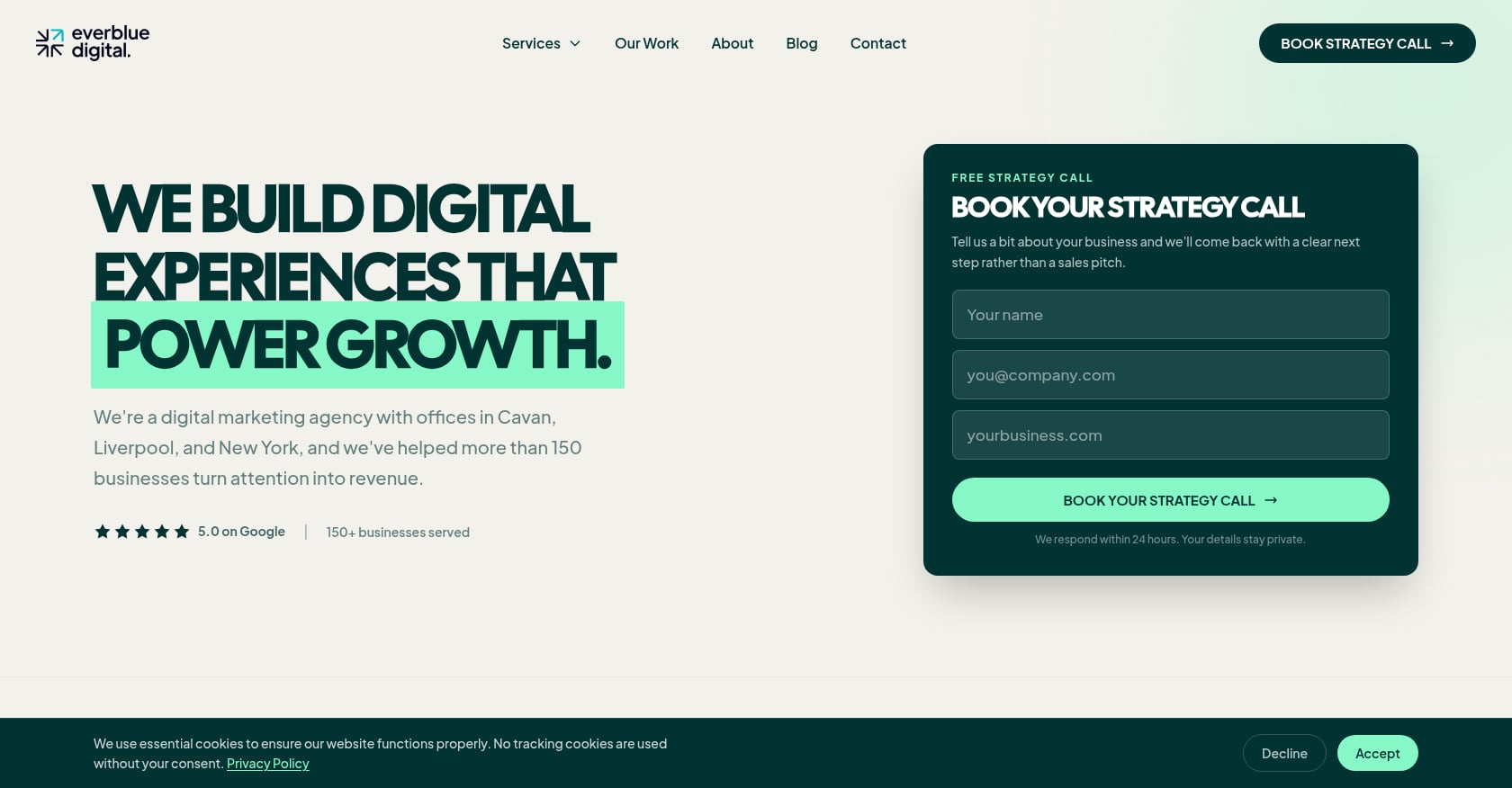
Best for: SMEs that need branding, website, and digital marketing execution together.
Everblue serves local and regional businesses across Ireland, the UK, and the US. They list 150+ businesses served, 10+ years in business, and a 5.0 Google rating.
Pricing: “Digital Marketing Partnerships from €3,000/month” is visible on their site, though that appears to refer to retained digital marketing rather than standalone brand positioning projects.
Key capabilities:
Brand strategy development
Logo design and visual identity
Brand guidelines and style guides
Brand messaging and voice
Brand launch strategy and implementation support
Brand training sessions
Web design, SEO, paid advertising, and social media
Proof: Trustburn shows Everblue with 4.2 from 19 reviews, including praise for professionalism, website performance improvements, and communication.
Tradeoffs:
Stronger fit for SME web/marketing packages than complex B2B repositioning
Less clearly specialised in enterprise buying groups, medtech, manufacturing, or distributor enablement
Useful pricing benchmark because they publish a retainer starting point
Verdict: Choose Everblue if you are an SME looking for branding, website, and digital marketing execution under one roof.
How to Choose a B2B Brand Positioning Agency
The comparison table narrows the field, but the real decision depends on what your business actually needs. Here is a practical checklist.
Can they diagnose the commercial problem?
Good agencies ask hard questions before recommending solutions. They should want to know: where does the sales process stall? Which segments are most profitable? Which buyers misunderstand the offer? Which competitors are easiest to confuse you with? What proof does the market already trust?
If the first conversation is about colour palettes, walk away.
For a closer look at how CSM approaches diagnostics, their process starts with identifying commercial leverage points before execution begins.
Can they handle the full buying committee?
Ask whether the agency maps messaging for the CEO, CFO, technical evaluator, procurement lead, operations, end user, and internal champion. As one practitioner on Reddit noted, many B2B teams create content for one buyer persona while enterprise decisions involve many stakeholders. That gap kills deals.
Can they turn positioning into assets sales can use?
Positioning is worthless if the sales team cannot use it. Look for agencies that deliver pitch decks, capability statements, proposal templates, case studies, ROI narratives, and objection-handling messages. Practitioners on Reddit report that deals move when champions can forward business cases, risk answers, and clear timelines internally.
CSM’s work for Arrotek is a useful example: segmented GTM, a productised “Prototype Sprint” offer, outbound infrastructure, and ABM coaching, all built from the same positioning foundation.
Can they implement the position on the website?
The website is where B2B brand positioning either lives or dies. Look for UX journey mapping, conversion-focused copy, SEO architecture, and CMS control. If the agency builds a beautiful brand but hands off the website to a separate developer, expect gaps.
Website strategy and development should be treated as an extension of positioning, not a separate project.
Can they make the brand easy to find?
Ehrenberg-Bass defines physical availability in B2B as presence, prominence, and portfolio: being where buying happens, easy to find in sales environments, and offering a portfolio that addresses buyer needs. Today, that includes Google, AI search platforms, distributor portals, and partner ecosystems.
Ask your agency how positioning connects to SEO and AI search visibility. If they have no answer, you will build a brand that is easy to admire but hard to discover.
Can they measure commercial impact?
Ask about qualified organic traffic, enquiry quality, conversion rates, branded search growth, pipeline attribution, and content-assisted pipeline. If the only measurement is “brand awareness,” the engagement will be hard to justify to your CFO.
Red Flags When Hiring a B2B Brand Positioning Agency
They start with visuals before strategy. If the first deliverable is a moodboard, the agency may not be solving the business problem.
They cannot explain how B2B differs from B2C. B2B positioning must account for buying groups, long sales cycles, rational and emotional risk, and internal consensus. An agency that treats B2B like “B2C with longer contracts” will produce positioning that sounds good in a boardroom but fails with procurement.
They only interview the leadership team. Leadership input matters, but buyer interviews, lost-deal analysis, and competitor review are often where the truth sits.
They deliver a positioning deck with no activation plan. As LinkedIn practitioner Veb Bansal argues, the market decides whether a company is allowed to occupy a position. A strategy deck without activation across website, content, sales collateral, and campaigns will not earn that permission.
Their positioning does not show up beyond the homepage. LinkedIn practitioner Lawson Abinanti describes this as “one-and-done positioning.” The position should become the theme across service pages, proposals, case studies, email sequences, distributor materials, and sales scripts.
Their proof is only awards. Awards signal craft, but B2B buyers should prioritise evidence of business outcomes, sector relevance, and implementation capability.
They cannot discuss pricing structure clearly. Even if pricing is custom, the agency should explain what drives cost.
How Much Does B2B Brand Positioning Cost in Ireland?
Most serious B2B brand positioning projects are custom-priced. Dublin agency directories show smaller branding projects starting from around €1,000 to €5,000, but those figures may only cover limited branding work, not deep research, positioning, messaging, identity, website implementation, and sales enablement.
Here is a realistic scope matrix:
Scope | What it typically includes | Pricing visibility |
|---|---|---|
Basic brand refresh | Logo, colours, typography, light messaging | Often starts in low thousands |
Positioning sprint | Workshops, competitor review, ICP, messaging | Usually quote-based |
Positioning + identity | Strategy, messaging, visual identity, guidelines | Quote-based |
Positioning + website | Strategy, messaging, UX, copy, SEO, design, dev | Higher custom scope |
Positioning + growth system | Website, SEO, sales enablement, analytics, ongoing optimisation | Project + retainer |
Hidden costs to ask about
Many B2B positioning projects carry costs that are not included in the initial quote: customer interviews, competitor research, brand naming, verbal identity, sales deck redesign, website copywriting, SEO migration, photography, brand guidelines, rollout training, CMS implementation, and measurement dashboards.
Ask every agency for a breakdown across research, strategy, messaging, identity, website implementation, sales enablement, SEO/GEO support, rollout, and ongoing optimisation.
To understand how brand contributes to commercial value beyond visual identity, consider the compounding returns of positioning that is properly activated.
A Decision Filter
Not every business needs the same agency. Here is a simple way to match your situation to the right type of partner:
Need a logo refresh? Choose a design-led brand studio like Design Minds or Red & Grey.
Need B2B tech campaigns fast? Compare Squaredot.
Need structured workshops and brand clarity? Compare CDG or SHAPE.
Need premium repositioning or acquisition prep? Compare Seichō.
Need brand positioning that connects into website conversion, SEO, AI search, sales enablement, and commercial growth? Talk to CSM.
The best B2B brand positioning agency is not the one with the nicest portfolio. It is the partner that helps your business make a clear strategic choice, prove that choice to the market, and repeat it across every touchpoint buyers use to judge you.
If your positioning is unclear, your website, SEO, and sales materials will all work harder than they should. Book a free 30-minute consultation with CSM Agency to identify the commercial foundations your brand needs next.
FAQs
What is B2B brand positioning?
B2B brand positioning is the strategic definition of who your business serves, what market problem it owns, what makes it meaningfully different, and why a buying group should trust and choose it over alternatives. It is not a tagline or a logo. It is the commercial foundation that shapes messaging, identity, website architecture, sales materials, and search visibility.
How is B2B positioning different from B2C positioning?
B2B positioning has to convince multiple stakeholders, reduce perceived risk across a committee, support internal consensus, and translate into procurement-ready proof, technical evidence, and long-cycle buying materials. B2C positioning typically targets an individual making a faster, lower-risk decision.
When should a B2B company reposition?
Common triggers include entering a new market, moving upmarket, launching a new service, preparing for acquisition, sales teams being inconsistent in how they explain the offer, a website that no longer reflects business value, competitors sounding identical, organic traffic that does not convert, or pricing power declining.
How long does a B2B positioning project take?
It varies. Seichō publicly states that comprehensive B2B branding projects typically take 8 to 14 weeks. A narrower positioning sprint may be shorter. Positioning combined with identity, website redesign, SEO architecture, and rollout will take longer.
What deliverables should a B2B positioning project include?
At minimum: market and competitor review, ICP and buyer-group mapping, customer research, positioning strategy, value proposition, messaging hierarchy, proof points, tone of voice, website messaging direction, and brand guidelines. Stronger projects also include website UX and conversion maps, SEO content architecture, sales decks, case study frameworks, thought leadership pillars, distributor enablement, and analytics dashboards.
Can SEO help B2B brand positioning?
Yes. SEO turns positioning into discoverable content across category pages, service pages, comparison content, case studies, and thought leadership. In AI search and traditional search, consistent structured content helps explain what your brand does, who it helps, and why it is credible. LinkedIn’s 95-5 rule research shows that most category buyers are not in-market today, which means SEO-driven content builds the memory structures that lead to future shortlisting.
Should we hire a brand agency, web agency, or SEO agency first?
If the problem is unclear positioning, fix that before investing heavily in traffic. If the brand is clear but the website cannot convert or rank, web and SEO may be the priority. For many B2B firms, the most efficient path is an integrated partner that connects positioning, website, SEO, sales enablement, and measurement from the same strategy.
Is brand positioning worth the investment for B2B companies?
Yes, if it is activated. B2B buyers often shortlist known and trusted vendors before formal sales engagement. The winning vendor is on the Day One shortlist 95% of the time. Positioning helps a business become easier to remember, easier to trust, easier to compare, and easier to buy. The return compounds over time through stronger conversion rates, shorter sales cycles, and higher pricing power.